
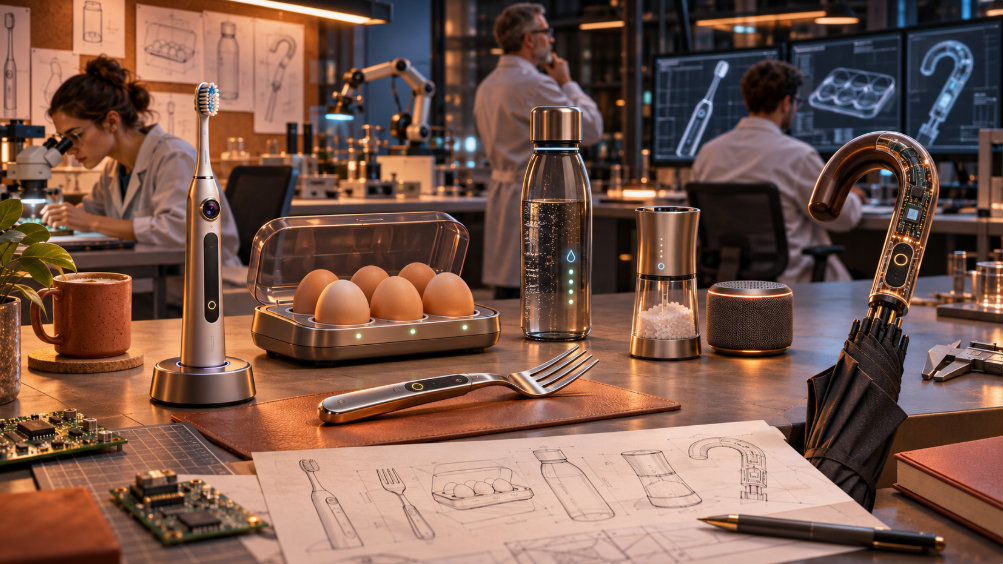
Or: When even I think technology has gone too far.
A friend once suggested that somewhere in the world there is a laboratory full of highly qualified engineers whose entire research and development strategy revolves around one question:
“If we invent this gadget, will Jon buy it?”
I have to concede that there’s probably some truth in this.
I like gadgets. I’ve always liked gadgets. I’m fascinated by technology, clever engineering and people finding ingenious ways to solve problems. Occasionally, I’ll even buy something simply because I admire the ingenuity involved, rather than because I have any pressing need for it.
There have undoubtedly been occasions when my enthusiasm for a clever piece of technology has exceeded the practical justification for purchasing it.
Which makes it all the more concerning when a new product appears and even I find myself asking:
Why?
The latest example is Dyson CameraJet, an electric toothbrush equipped with a camera, machine learning, Wi-Fi connectivity and an app. Its camera captures and analyses 28 images every second, allowing the device to identify gaps between the teeth and direct its liquid jet towards them.
A camera.
Inside a toothbrush.
Apparently, Dyson spent six years developing it.
Six years during which I suspect nobody asked the fairly obvious question: Do people actually want a camera inside their toothbrush?
I’m sure it’s a remarkable piece of engineering. But so was Concorde, and at least that took you somewhere.
This got me thinking about the extraordinary number of inventions that seem to exist primarily because somebody discovered they could make them, rather than because anybody had actually asked for them.
There is, after all, a fine line between the relentless pursuit of technological progress and equipping a salt shaker with a Bluetooth speaker.
I fear we crossed it some time ago.
So, alongside my other Top Tens, here is a slightly less personal collection:
Ten Gadgets the World Never Needed.
And because mere ridicule seems insufficient, I’ve devised a scientific scoring system.
Well, scientific in much the same way that putting Bluetooth in a fork constitutes progress.
Each gadget is assessed against five criteria, with a maximum of five points in each:
- Problem nobody knew existed: How successfully has technology solved something that wasn’t actually a problem?
- Likelihood of requiring an app: How much unnecessary smartphone involvement has been introduced?
- Server dependency: How vulnerable is its cleverness to the manufacturer turning something off?
- Embarrassment factor: How difficult would it be to explain the purchase to a visitor without looking foolish?
- The “No. Just no.” score: My entirely subjective assessment of the whole enterprise.
A perfect score is 25.
And not in a good way.
One important qualification: every gadget on this list is real.
Some reached the shops. Others were launched or crowdfunded. I’ve included links because otherwise you might reasonably assume I had made them up.
If only I had.
10. The Water Bottle That Reminds You to Drink Water
HidrateSpark PRO 2 · 16/25
Water is, by general consensus, quite important to human survival.
For several million years, however, our ancestors managed to consume it without the assistance of Bluetooth.
HidrateSpark decided that this arrangement was no longer satisfactory.
Its smart water bottle monitors consumption, communicates with a smartphone and lights up to remind its owner to drink. The current PRO 2 version can also make sounds, track individual sips through Bluetooth and even incorporate Apple Find My, just in case you lose the device responsible for reminding you not to become dehydrated.
I can see a limited argument for people who genuinely struggle to maintain their hydration, and I’m sure there are circumstances in which such monitoring is useful.
But I find something rather wonderful about the idea that our bodies have evolved a sophisticated biological system called thirst, only for somebody to decide it needed replacing with an illuminated drinking vessel.
And, naturally, an app.
I can only assume that the next version will include artificial intelligence to analyse whether the water is sufficiently wet.
My verdict: Technology has successfully reinvented being thirsty.
Proof that it exists: HidrateSpark PRO 2 official product page
9. The Hairbrush That Assesses Your Performance
Kérastase Hair Coach Powered by Withings · 18/25
In 2017, Kérastase Hair Coach Powered by Withings appeared: a smart hairbrush containing a microphone, load cells, accelerometer, gyroscope and conductivity sensors. It was designed to analyse brushing patterns, communicate by Wi-Fi or Bluetooth and produce a hair quality score through an accompanying app.
Apparently, ordinary hairbrushes had been failing us for centuries.
I have to admit that the engineering is quite clever.
But the idea of receiving a performance report from one’s hairbrush seems a step too far.
Imagine getting ready for work and discovering that your hairbrush has assessed your performance as Below Expectations.
I spent enough years dealing with performance management systems at work.
I refuse to undergo an appraisal from my hairbrush before breakfast.
And I particularly object to the possibility that the hairbrush might know more about my hair than I do. Although, looking at it, that may not be an especially high bar.
My verdict: We have reached the point where even personal grooming requires management information.
Proof that it exists: L’Oréal’s original announcement (PDF)
8. The Internet-Connected Egg Tray
Quirky Egg Minder · 21/25
For most of recorded history, determining the number of eggs in one’s refrigerator has involved a relatively straightforward procedure.
You open the refrigerator.
You look at the eggs.
You count them.
Quirky Egg Minder concluded that this system was unnecessarily dependent on human intervention.
The Wi-Fi-connected tray held up to 14 eggs, communicated with a smartphone app, notified its owner when supplies were running low and used an LED to identify the oldest egg.
This meant that you could be standing in the supermarket, wondering whether you needed eggs, and consult your phone rather than attempting to remember what was in the fridge.
There is a certain logic to that, I suppose.
But it also meant that buying eggs had become an activity requiring electronic sensors, a wireless network and software.
And I can’t help wondering what happens if you have 15 eggs.
Presumably, the entire system collapses into confusion.
My verdict: We have successfully replaced opening the fridge with opening an app. The eggs remain in exactly the same place.
Proof that it exists: Quirky Egg Minder user manual
7. The Fork That Tells You Off
HAPIfork · 20/25
I have occasionally been accused of eating too quickly.
Normally, this observation comes from another human being, usually someone sitting across the table from me.
The inventors of HAPIfork decided that this responsibility should be transferred to the cutlery.
The electronic fork monitored “fork servings”, measured eating speed and intervals, and used indicator lights and vibrations to alert its owner when food was being eaten too quickly. Data could then be uploaded via USB or Bluetooth for further analysis.
And this wasn’t simply someone’s prototype. Its Kickstarter campaign attracted 1,268 backers and raised $134,743.
So there was evidently significant public demand for cutlery capable of expressing disappointment.
I can appreciate the health argument. Eating more slowly may be beneficial, and there may be people for whom the device genuinely helps.
But the prospect of having dinner interrupted by a vibrating fork seems a rather bleak development in human civilisation.
Imagine sitting down to a lovely meal, only to discover that your cutlery disapproves of your enthusiasm.
We’ve spent centuries perfecting the simple fork:
Four prongs.
A handle.
No operating system.
It is one of humanity’s great design achievements.
Apparently, this wasn’t enough.
My verdict: At last, cutlery that combines the nutritional benefits of eating with the emotional experience of being nagged.
Proof that it exists: HAPIfork’s original Kickstarter campaign
6. The Wine Bottle That Needed Software
Kuvée · 22/25
Now this is an invention that ought to appeal to me.
I like wine.
I like technology.
Surely, combining the two could only lead to something wonderful.
Kuvée developed a connected wine dispenser using a proprietary bottle system. The idea included preserving opened wine for a claimed 30 to 60 days and creating a connected ecosystem through which customers could obtain more wine.
The preservation part is a genuinely useful idea.
But somewhere along the way, somebody decided that drinking a glass of wine should involve a proprietary technological ecosystem.
And then, in 2018, the company shut down.
There is something rather poignant about this.
For thousands of years, wine has been stored in amphorae, barrels and bottles. The technology gradually improved, culminating in the modern glass bottle and cork.
You can open one without a proprietary technological ecosystem.
You can pour it without an internet connection.
And, provided the wine is good, you can continue enjoying it even if the vineyard’s IT department has a catastrophic failure.
5. The Remotely Operated Dog-Treat Launcher
Petcube Bites · 21/25
I had to check this one several times.
Petcube Bites is an internet-connected pet camera that allows its owner to watch and talk to a pet remotely and, crucially, fling treats across the room using a smartphone.
The manufacturer advertises the ability to control the distance and number of treats launched.
Yes.
Fire treats.
You can be sitting in a hotel room in Manchester, watching your dog in Surrey, and launch a biscuit across the kitchen.
From your phone.
I am genuinely struggling to imagine the original product development meeting.
“People love their dogs.”
“Absolutely.”
“They miss them when they’re away.”
“Of course.”
“What if we gave them the ability to launch biscuits at the dog from another county?”
“Brilliant. Let’s build it.”
To be fair, I can see the appeal of checking on a pet while you’re away. And I’m sure the dog finds the arrival of unexpected biscuits deeply satisfying.
But I suspect the dog is perfectly happy with the technological arrangement for entirely different reasons.
It can now obtain food without the inconvenience of having to interact with its owner.
My verdict: Remote-controlled biscuit artillery. I genuinely don’t know what else to say.
Proof that it exists: Petcube Bites 2 Lite official product page
4. The Umbrella That Tells You It’s Raining
Oombrella · 23/25
Now we’re getting into serious territory.
Oombrella was a crowdfunded smart umbrella designed to communicate with a smartphone, warn when rain was approaching and notify its owner when the umbrella had been left behind. It successfully raised €60,420 from 733 Kickstarter backers in 2016.
To be fair, an umbrella that prevents you leaving it in a restaurant may be evidence that technology has finally identified one genuine umbrella-related problem.
I have certainly left umbrellas in places where they would have been more useful had they remained in my possession.
But the idea of an umbrella sending you a notification that it’s going to rain is rather extraordinary.
There is already a remarkably sophisticated piece of technology for determining whether it is raining.
It’s called a window.
Unlike the umbrella, it doesn’t need charging.
Other reliable methods include looking upwards and, in particularly severe cases, getting wet.
The engineering is undoubtedly clever.
But I remain unconvinced that an object whose sole purpose is to keep rain off your head needs a software ecosystem concerned with the existence of rain.
I also wonder about the sequence of events.
You open the umbrella.
Rain begins to fall.
Your phone vibrates.
You take your phone out of your pocket.
A notification informs you that it is raining.
Your phone gets wet.
Progress.
My verdict: For thousands of years, humanity relied on noticing water falling from the sky. Now your umbrella can confirm it.
Proof that it exists: The original Oombrella Kickstarter campaign
3. The Toilet With Amazon Alexa
Kohler Numi 2.0 · 23/25
There are some places where technology has made a genuinely positive difference.
Modern plumbing, for example, is something for which we should all be profoundly grateful.
Heated toilet seats may also be a perfectly reasonable luxury, particularly in winter.
But then along came the Kohler Numi 2.0.
The smart toilet incorporates a heated seat, built-in speakers, automatic functions, app connectivity, adjustable washing and drying, automatic deodorisation and Amazon Alexa.
Yes.
Alexa.
In the toilet.
At the time of writing, Kohler’s US website was offering the white version for just under $13,000, reduced from a list price of more than $17,000. Other finishes cost even more.
For a toilet.
I realise it does quite a few things.
Nevertheless, it remains fundamentally a toilet.
A toilet with a better sound system than some people’s living rooms, admittedly, but still a toilet.
I can think of few circumstances in which I would wish to have a conversation with my toilet.
And even fewer in which I would want my toilet to have access to an internet-connected voice assistant.
I can imagine the scene at a dinner party.
“Excuse me, where’s the bathroom?”
“Upstairs, second door on the left.”
“Thank you.”
“Oh, and don’t be alarmed if Alexa starts talking to you.”
There are, admittedly, some excellent features here. Touchless operation, automatic cleaning and adjustable washing may all be very welcome.
But the ability to involve Amazon Alexa in one’s bathroom routine seems to have crossed a boundary.
A boundary that probably should have remained firmly closed.
My verdict: We have finally reached the stage where the toilet can participate in the conversation. Personally, I’ve always considered the bathroom somewhere one goes to escape conversation.
Proof that it exists: Kohler’s official Numi 2.0 announcement
2. The Bluetooth Salt Shaker
SMALT · 25/25
This may be the most extraordinary invention in the entire collection.
And I say that as someone who genuinely loves music.
SMALT was promoted as a smart salt dispenser incorporating mood lighting, a Bluetooth speaker, smartphone controls and measured salt dispensing.
The app could even be instructed to dispense a pinch, a dash or a precise measurement, because apparently shaking salt by hand lacked sufficient accuracy and administrative oversight.
Let me repeat the important part.
A salt shaker. With a Bluetooth speaker.
I have spent a lifetime listening to music, buying records, attending concerts and enjoying the extraordinary creativity of musicians.
I have seen Paul McCartney perform live.
I have listened to everything from the Beatles to Miles Davis, Pink Floyd to Steely Dan.
I cannot think of a single occasion, in all those years, when I have been seasoning my dinner and thought:
You know what this salt shaker needs? A subwoofer.
I can understand wanting music in the dining room.
I can understand wanting adjustable lighting.
I can even understand being interested in one’s salt consumption.
But combining all three into a single piece of tableware seems to suggest that somebody has misunderstood the entire purpose of product design.
Imagine being halfway through dinner when the music stops.
“What’s happened?”
“The salt shaker’s lost its Bluetooth connection.”
“Have you tried turning the seasoning off and on again?”
And presumably, if you want pepper, you need to buy the stereo version.
This is not technological progress.
This is an intervention waiting to happen.
My verdict: Somewhere in the world, somebody looked at a perfectly functional salt shaker and decided the missing ingredient was music.
Proof that it exists: SMALT manufacturer’s original 2017 announcement
1. The Camera-Equipped AI Toothbrush
Dyson CameraJet · 24/25
And so we return to the invention that started this entire exercise.
Dyson CameraJet.
It costs £419.99.
For that, you get an extraordinarily sophisticated electric toothbrush incorporating a miniature camera, machine learning, Wi-Fi connectivity, a precision liquid jet and integration with the MyDyson app.
The camera captures and analyses 28 images every second, allowing the device to identify gaps between the teeth and direct its liquid jet towards them.
Twenty-eight images every second.
My current toothbrush analyses none.
This is partly because it is a toothbrush and knows its place.
Admittedly, my current toothbrush has never crashed, asked for my Wi-Fi password or required a firmware update.
Now, I don’t doubt that Dyson’s engineers have done something genuinely clever.
The camera is designed to identify gaps between teeth and enable a precision jet to clean between them. The company says the product was the result of six years of research, development and engineering.
And the app provides live viewing, guided cleaning and coverage mapping.
Live viewing.
Of the inside of my mouth.
While I’m brushing my teeth.
Dyson says that the camera images are not stored or shared, which is reassuring.
Nevertheless, I cannot escape the feeling that there are some places where I don’t particularly require a connected camera.
And my mouth, while standing in the bathroom first thing in the morning, is quite high on the list.
I am also intrigued by the implications for the future.
Will the toothbrush eventually provide even more personalised feedback?
Could there be a monthly subscription?
Will an upgrade offer improved gum analytics?
Might we one day find ourselves standing in the bathroom, unable to brush our teeth because the toothbrush is downloading a firmware update?
I recognise that this is speculation.
But once your toothbrush is examining your mouth 28 times every second and displaying the results live on your smartphone, I don’t think it’s entirely unreasonable speculation.
There is something particularly unsettling about giving a toothbrush a machine-learning algorithm and then instructing it to look at your teeth.
My verdict:
A camera.
In your mouth.
Connected to Wi-Fi.
No. Just no.
Proof that it exists: Dyson CameraJet official UK product page
The Wensley Index of Technological Pointlessness
For those interested in the scientific rigour underpinning this assessment, here are the final results.
| Gadget | Score | Would Jon buy it? |
|---|---|---|
| HidrateSpark | 16/25 | Hmm... |
| Kérastase Hair Coach | 18/25 | No |
| Quirky Egg Minder | 21/25 | No |
| HAPIfork | 20/25 | No |
| Kuvée | 22/25 | Dangerously plausible |
| Petcube Bites | 21/25 | If I had a dog... |
| Oombrella | 23/25 | No |
| Kohler Numi 2.0 | 23/25 | Not at $13,000 |
| SMALT | 25/25 | No. Just no. |
| Dyson CameraJet | 24/25 | Apparently even I have limits |
I should perhaps point out that the numbers do not entirely correspond to the ranking.
This is partly because the Wensley Index of Technological Pointlessness is still at an early stage of development and has yet to undergo peer review.
It is also because this is my list, and the toothbrush annoyed me more.
A Bluetooth version is planned.
Have They Finally Gone Too Far?
I should probably emphasise that I am not opposed to technology.
Far from it.
I have enough connected devices around the house to ensure that, should they ever become self-aware, I will be hopelessly outnumbered.
Clever technology solving real problems is wonderful.
Clever technology solving imaginary problems can be entertaining.
And occasionally it gives us a salt shaker with a Bluetooth speaker.
Which brings me back to my friend’s theory.
Somewhere, perhaps, there really is a laboratory full of engineers asking:
“If we invent this gadget, will Jon buy it?”
If so, I fear this list may cause some concern at the next product-development meeting.
Because if you can produce a Wi-Fi egg tray, an Alexa-enabled toilet, a fork that tells me off, a musical salt shaker and a £420 toothbrush with a camera inside it...
and even I don’t want them...
we may finally have discovered the limits of technology.
Although I have to admit that the dog-treat launcher is quite clever.
Damn. They’ve got me again.
Hilarious Jon. Have to say we have had conversations with pet owners who have a dog-treat camera launcher and think they are great. The dogs are very keen too!
Maybe you will just have to borrow/buy a dog to try it out.😉